Finance in hospitals is a complicated thing. Unfortunately every 1 in 5 hospitals could be considered high risk for financial default. A default occurs when a loanee fails to make required payment. Some hospitals in Europe are constantly facing financial deficits or insolvency issues. In Australia, Victorian public hospitals operated at a major deficit of $1+ billion in 2024. Also in the year 2024, Japan had 90% of public run hospitals operating at a deficit. The country of Hungary had €300 in past due hospital debt. What is going to help hospitals and healthcare facilities keep pace? Spending on high quality tech, that will boost efficiency in the workplace.
Time based delivery policies on blood delivery. In Norway blood products must reach wards within 15 minutes. Meaning delivery methods of blood products must be fast and capable. Special legislations include The NIS2 directive, an extensive European Union law designed for achieving common level cybersecurity across the EU. The KRITIS regulation, a German legal framework for protecting critical infrastructure, such as energy, water and transport, ensuring public safety.
Reforms to remark, the INVIMA reform in Colombia is a structural modernization plan by the National Institute for drug and food surveillance. The Dubai law No.5 of 2025, is a complex public health legislation issued by the Ruler of Dubai, establishing a solid legal network for disease prevention and food safety. In select permitted cities in China, there are fully owned foreign hospitals.
Many hospitals around the world are about to face a nurse deficit of 4.5 million nurses by the year 2030, some countries are seeing the deficit now. The suggested optimal ratio of nurses per 100,000 inhabitants is 20,000 nurses, yet countries like Greece, Romania, Croatia and Latin American & Caribbean all have under 400 nurses per 100,000 inhabitants each. While countries such as Finland and Ireland have under 1,400 nurses. This is significantly lower than the suggested amount. According to National Nurses United 1 nurse to every 5 patients is optimal, but depending on country and position a nurse can see up to 11 patients per day.
Additionally the aging population could be contributing to the nurse deficit, 1 in 6 people globally will be 60 years of age or older by 2030. Finding people in the nursing profession is slowly becoming more rare. Perception of unfair wages, 57.2% of healthcare workers feel they are not paid fairly for the work they do. High physical strain and stress is common as well, with 84.5% of nursing staff mentioning physical pain on the job and 70% stating levels of high stress. This leads to burnout and could affect the ability to give patients ideal care.
What is going to help nursing staff with their workload? Updating to modern tech, built with a purpose to make hospitals more efficient. Pneumatic tube systems are safe, secure cutting edge tech built with IT security in mind. In 2024, of surveyed healthcare organizations throughout the world, 67% of them were affected by ransomware. That is a high percentage. In UAE The American Hospital Dubai, lost 450 million PHI records in 2025. And in China cyberattacks rose 6% in 2025 compared to 2024.
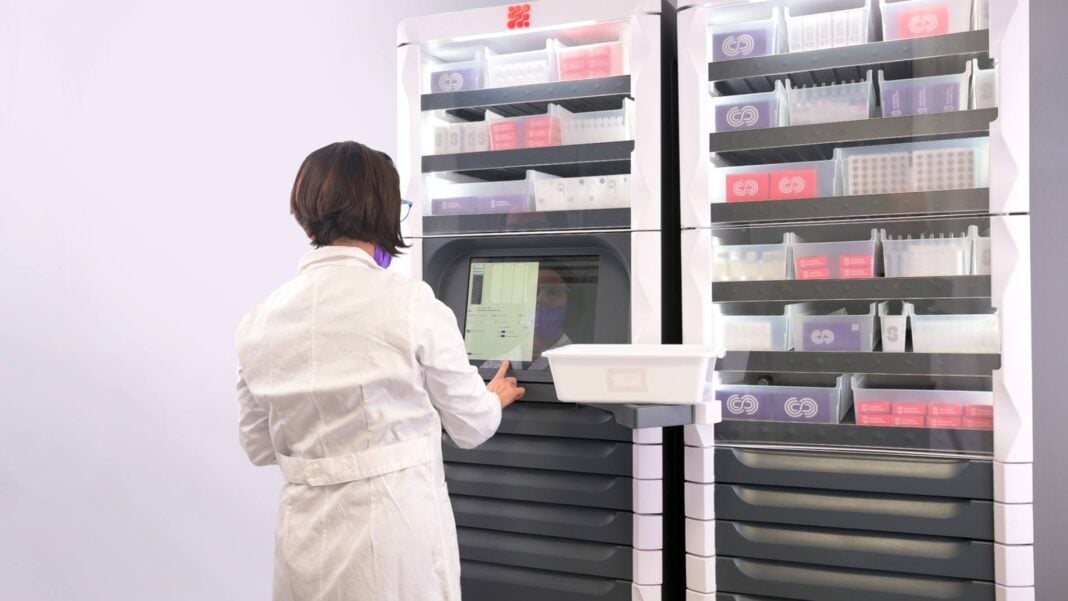
Benefitting patients and clinical staff alike, a Pneumatic tube system is built for speed. It works like a small subway network, delivering important units throughout a hospital. Staff can tap their badge to access the tube station’s interface. Load carriers for different destinations, i.e, pharmacy vs ward. Key in the destination of the carrier through a touchscreen. Let the system automatically determine the fastest route and manage traffic to arrive 5x faster than human couriers. Staff can track carriers with real time RFID tracking technology.
Delivery of lab samples, cancer medication and blood products becomes 8x faster. It handles over 10k transactions a day. Patient records are delivered 700% faster than human walkers. Hospital pharmacies are able to transport 90% of their materials in a carrier. Making a pneumatic tube system the most practical and efficient way to deliver products throughout modern hospitals. Building an infrastructure that assists nurses in increasing their speed and ability to assist patients up to 10x faster. All this and more proudly provided by Swisslog healthcare, a member of the KUKA group.

Source: Swisslog