For Amanda Pierce, motherhood was never a single moment or a clearly defined beginning. It arrived gradually, through grief, responsibility, and a willingness to step into roles she never expected to carry so early. It arrived through loss, through uncertainty, and through the quiet decision to show up for the people who needed her most.
Long before she became a biological mother, Amanda became something else first: a steady presence in the lives of her nephews after her sister passed away unexpectedly. At the time, they were just two and five years old—children whose lives had been permanently altered by absence. Without hesitation, Amanda stepped in to help raise them, offering stability during a period defined by confusion and loss.
She did not yet know it, but that decision would become the foundation of her identity.
Motherhood, she would later come to understand, is not defined solely by birth. It is defined by devotion.
Stepping Into Motherhood Before She Expected To
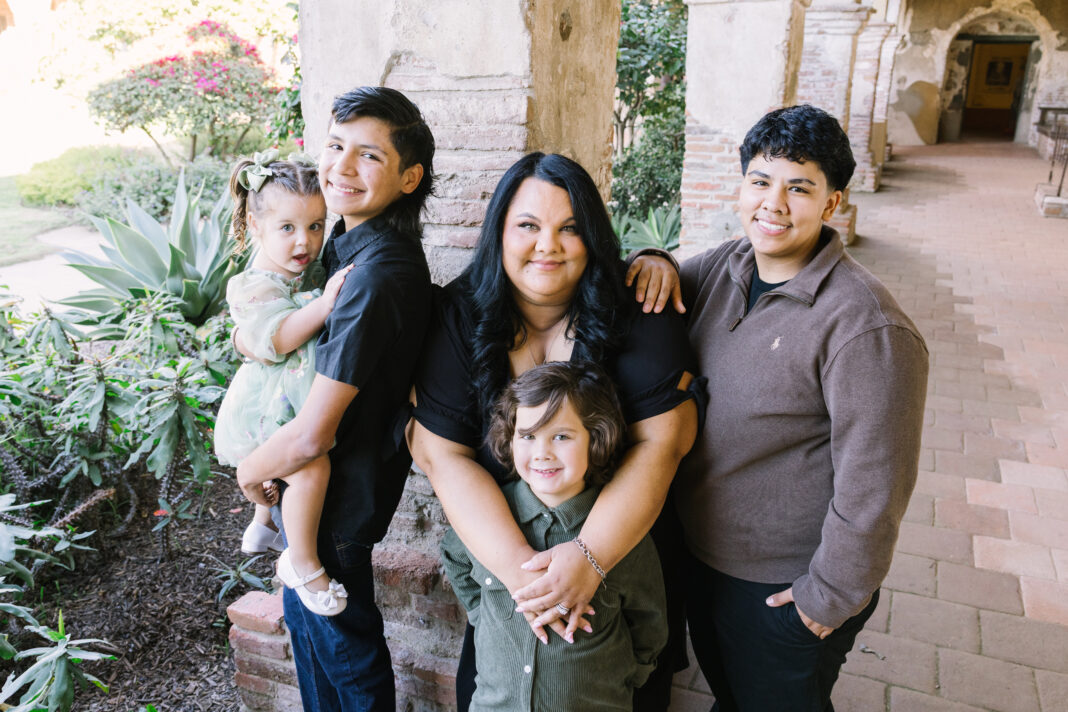
Today, Amanda’s home reflects the layered reality of motherhood in its fullest form. Her oldest nephew, now eighteen, lives with her full-time as he navigates the transition into adulthood. His life is filled with college responsibilities, part-time work, and the gradual independence that comes with learning to drive and prepare for the future. Her younger nephew, now fifteen, remains equally central to her life, even though distance requires sacrifice. Every other weekend, Amanda makes a four-hour round trip to Fontana to ensure he remains connected to the family structure she has worked so hard to preserve.
These efforts are not driven by obligation alone. They are driven by love and by a deep understanding of how essential consistency is to a child’s sense of security.
Alongside her nephews, Amanda is raising her own children—a six-year-old son whose quiet bravery and kindness shape the emotional center of their home, and a two-year-old daughter whose energy fills every room she enters. Their personalities, so different yet equally vibrant, represent the full spectrum of childhood. Together, they create a household that is constantly in motion, filled with noise, laughter, responsibility, and purpose.
Motherhood, for Amanda, is not defined by simplicity. It is defined by fullness.
Caring for the Woman Who Once Cared for Her
As if raising four children were not enough, Amanda also carries another responsibility—one that reflects the cyclical nature of care itself. Her mother lives with her full-time, navigating the daily realities of Dementia, Parkinson’s disease, and tardive dyskinesia. The roles they once held have quietly reversed.
Amanda is now responsible for caring for the woman who once cared for her.
This transition carries emotional weight that extends beyond logistics. It requires patience, emotional endurance, and the ability to accept that the person who once provided stability now depends on her for the same sense of safety.
In many ways, Amanda finds herself living at the intersection of two forms of motherhood. She is raising children while simultaneously caring for a parent whose independence has faded. The experience has deepened her understanding of love—not as something defined by convenience, but as something sustained through commitment.
Despite the difficulty, she does not see this responsibility as a burden. She sees it as a continuation of the same love that has always existed between them.
The Long Road Through Infertility and Uncertainty
While Amanda had stepped into motherhood through her nephews, her journey toward biological motherhood was marked by years of uncertainty. She and her husband spent six years navigating infertility, enduring the emotional weight of believing that parenthood might never become part of their lives. Medical professionals offered limited optimism, leaving them to confront the possibility that their family might never grow in the way they had hoped.
Infertility introduced a form of grief that often exists in silence. It forced Amanda to confront questions without clear answers, to continue hoping in the absence of certainty. Yet even during those years of waiting, she held onto her belief that her story was not yet finished.
Through in vitro fertilization, she gave birth to her son, Hunter—a moment that transformed years of uncertainty into profound gratitude. Later, she conceived naturally and welcomed her daughter, Dolly, into the world.
These experiences reshaped her understanding of motherhood. She did not take its presence for granted, because she had lived without its guarantee.
Her journey also gave her a new sense of purpose. Having experienced the isolation that often accompanies infertility, she chose to speak openly about her experience. Over time, she became a source of support for others navigating similar struggles, offering reassurance rooted not in theory, but in lived experience.
She understood what it meant to feel alone. She wanted to make sure others did not have to remain there.
Discovering Strength Through Sacrifice and Devotion
Motherhood stretched Amanda in ways she never anticipated. It required her to manage multiple schedules, emotional needs, and responsibilities simultaneously. There were moments when the demands felt endless, when exhaustion and doubt coexisted with purpose.
Yet through these challenges, she discovered something fundamental about herself.
She discovered resilience.
She discovered selflessness.
She discovered that motherhood was not something she performed, but something she lived.
Her days are filled with responsibilities that often go unnoticed. Coordinating schedules. Providing emotional support. Maintaining the structure that allows her family to function. Much of this work happens quietly, without recognition, yet it forms the backbone of her household.
Amanda understands that mothers often operate behind the scenes, creating stability that others depend on without fully seeing the effort required to maintain it. She has come to recognize that this invisible work is not insignificant. It is essential.
Embracing the Purpose She Was Meant to Live
Amanda does not view motherhood as something she sacrifices herself for. She views it as something that revealed who she was always meant to become.
She knows that time will move forward, that her children will grow into adults with lives of their own. She knows that the routines she lives today—the family dinners, the car rides, the daily interactions—will eventually become memories.
But she does not rush through them.
She savors them.
She understands now that motherhood is not defined by permanence, but by presence.
Her journey has been shaped by loss, by waiting, and by responsibility that arrived earlier and in greater volume than she expected. Yet through every challenge, she chose to remain present.
She chose to love.
She chose to continue showing up.
Amanda’s story reflects a truth that exists at the heart of motherhood itself: that it is not defined by ease, but by devotion. It is built through sacrifice, sustained through resilience, and fulfilled through the quiet, daily act of loving others more than oneself.
And in that devotion, she has found not only purpose—but the life she was always meant to live.