Introduction
Japan’s generative AI market is undergoing an extraordinary transformation, accelerating innovation across industries and reshaping how content, services, and business processes are conceived and delivered. Driven by a strong digital infrastructure, government-backed AI initiatives, and an urgent need to address demographic and labor challenges, generative AI is now at the heart of Japan’s strategies for future competitiveness. From healthcare to entertainment and manufacturing, this technology is redefining productivity, creativity, and personalized user experiences in one of the world’s most technologically advanced societies.
Key Takeaways
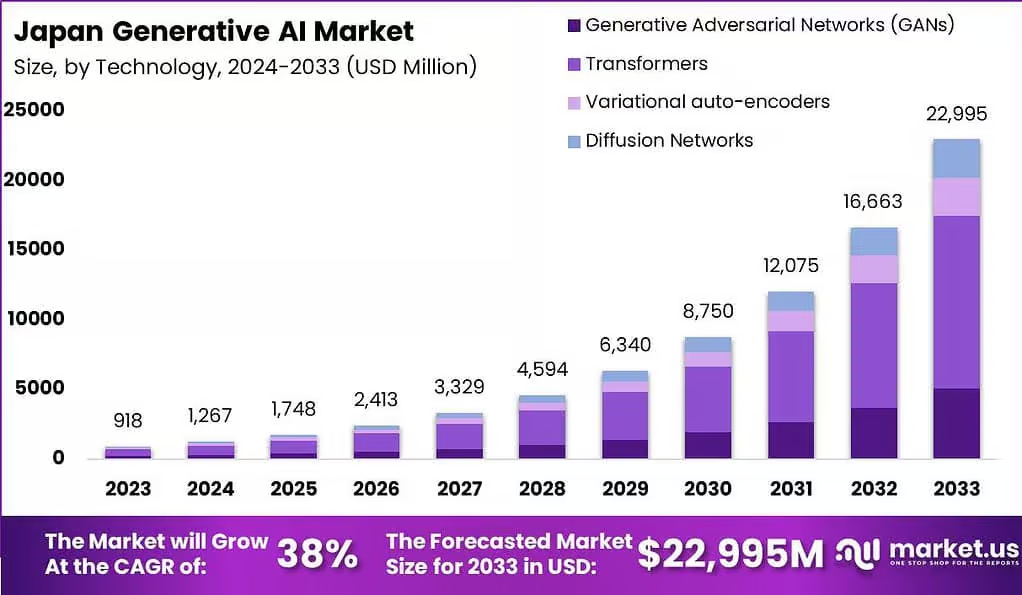
- Japan’s generative AI market is expected to soar from around $1.3 billion in 2024 to over $8–25 billion by 2030–33, growing at CAGRs ranging between 29.8% and 38.8% depending on the source and forecast horizon.
- Healthcare, media, finance, and manufacturing are among the sectors leading adoption, spurred by the need for automation, aging demographics, and the pursuit of innovative digital services.
- Software remains the largest revenue component, but AI-powered services are growing fastest as businesses demand tailored development, integration, and support.
- Market growth is fueled by R&D investments, a strong startup ecosystem, and widespread use of deep learning, GANs, and AI-powered personalization.
- Challenges include data security, skilled talent shortages, and the need for robust regulatory frameworks to ensure ethical, privacy-conscious AI deployment.
Component Analysis
The Japan generative AI market consists of fundamental components such as deep learning architectures (including GANs and autoencoders), model training platforms, data infrastructure, and cloud-based deployment environments. The ecosystem features comprehensive software suites that generate text, images, code, audio, and video content, often underpinned by high-performance computing capabilities. Emerging innovations leverage synergies with advanced hardware (such as GPUs and TPUs), collaborative APIs, and specialized algorithms designed for language, vision, and decision-making tasks. Increasingly, the market emphasizes scalable, explainable, and secure AI models tailored to local preferences and use cases.
Service Analysis
Service offerings in the Japan generative AI market range from AI model development and platform integration to custom solution deployment in verticals like healthcare diagnostics, creative design, marketing, and automation. Providers deliver consulting, managed AI services, data processing, workflow automation, and AI model fine-tuning—often through cloud-native, pay-as-you-go, or subscription models. Notably, the healthcare sector is leveraging AI for advanced imaging, drug discovery, and diagnostics, while commerce and entertainment deploy generative AI for content creation, personalized marketing, customer engagement, and immersive user experiences.
Key Player Analysis
The competitive landscape features a blend of global leaders—including Google, OpenAI, Microsoft, IBM, and NVIDIA—and prominent local innovators such as Preferred Networks, Abeja, Cinnamon, Ubie, Ascent Robotics, LeapMind, Stockmark, Studio Ousia, and Heroz. Startups are making significant inroads with domain-specific solutions, while collaborations between tech giants, academia, and sector specialists drive both technical advancement and application scale. Major Japanese corporations are also investing in generative AI capabilities to enhance digital transformation strategies and cross-industry collaborations.
Top Key Players in the Market
- Preferred Networks
- Abeja
- Cinnamon
- Ubie
- Ascent Robotics
- LeapMind
- Stockmark
- Studio Ousia
- Heroz
- Autify
Conclusion
Japan’s generative AI market is on a dynamic, upward trajectory, powering improvements in automation, creativity, and personalized digital experiences across the economy. As strong government support, significant R&D investment, and a diverse, innovative ecosystem converge, generative AI is set to play an ever-more vital role in addressing labor shortages, accelerating healthcare innovation, and enabling smarter, data-driven industries. The next decade promises increasing adoption, transformative applications, and strategic leadership by both global and homegrown technology players, firmly establishing Japan as a hub for generative AI excellence.