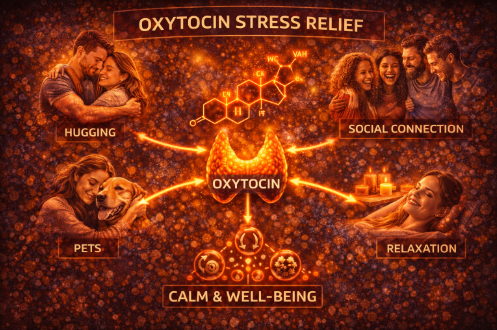
Oxytocin has a branding problem. In public conversation, it is framed as the love hormone, a chemical shorthand for romance and intimacy. In research and clinical discussion, oxytocin looks more like a social safety signal that can shape how the body responds to stress and how people seek connection under pressure. That shift matters because modern life is producing a new kind of chronic strain. It is not always dramatic trauma. It is long stretches of isolation, remote work, fragmented communities, and constant low-level alertness. In that environment, the phrase oxytocin stress relief captures a real question. Can social contact and social meaning change stress biology in measurable ways?
The answer is not a simple yes. Oxytocin can dampen parts of the stress response in some settings, yet its effects are strongly shaped by context, individual differences, and the kind of social environment a person is in. The best way to read the science is not as a promise of a calming spray. It is as a framework for why certain forms of connection, touch, and support can make stress feel more survivable and sometimes measurably less intense.
Oxytocin is a stress hormone too, just not in the way people expect
Oxytocin is produced in the brain and released both centrally and into the bloodstream. It has well-known roles in childbirth and lactation. The modern research focus is its broader role in social behavior and in regulating the stress response system, often discussed through interaction with the HPA axis. Reviews describe oxytocin as influencing social cognition and fear processing, and also as playing a role in stress regulation and adaptation.
A helpful reframing is this. Cortisol and adrenaline help you mobilize for a challenge. Oxytocin can support the recovery side of the stress cycle, especially when social connection is present. A 2021 review of oxytocin in stress, allostasis, and resilience discusses evidence that oxytocin can reduce HPA axis activity and anxiety-related responses in many experimental contexts.
That is the core biological logic behind oxytocin stress relief. It is not that oxytocin erases stress. It may help shift the body from fight or flight toward safety and repair when the environment signals that safety is real.
The modern workplace makes oxytocin relevant in a new way
The contemporary stress signature is often social. Not social conflict only, but social uncertainty.
Slack messages that never fully stop
Teams that rarely share physical space
Performance is measured through responsiveness rather than results
More screen time, less face time, fewer rituals
This not only creates anxiety. It can weaken the everyday social cues that tell the nervous system it is safe. When those cues are missing, the stress system may stay more reactive.
A 2024 Frontiers in Endocrinology paper describes oxytocin and stress systems as interacting, with long-lasting effects beginning early in life and influencing how stress regulation develops. Even though that lens includes early life, the same idea applies later. Humans regulate stress better inside supportive social contexts than in isolation, and oxytocin is one candidate mechanism for that social buffering.
Social buffering is the most important non-romantic oxytocin story
The strongest and most useful concept in this area is social buffering. It means supportive social presence can reduce the physiological and emotional impact of stress.
Human studies suggest oxytocin and social support can combine in ways that reduce stress responses. A 2020 review focused on oxytocin and the stress buffering effect of social company discusses findings where participants receiving both social support and intranasal oxytocin showed lower anxiety, cortisol, and autonomic activity compared with other conditions, while also emphasizing that effects can vary across studies and contexts.
This is a very different story from oxytocin as romance. It is oxytocin as a bridge between connection and stress physiology, especially when the connection is experienced as safe.
If you want a practical translation, the oxytocin story supports the idea that one high-quality supportive interaction can sometimes do more for stress load than another hour of scrolling self-care content.
Why intranasal oxytocin research is both promising and frustrating
Intranasal oxytocin became popular because it offers an experimental tool to test whether oxytocin can change human stress responses and social processing.
Some studies show meaningful effects. For example, a 2014 meta-analytic review reports that intranasal oxytocin showed greater attenuation of cortisol responses during laboratory tasks that strongly activated the HPA axis, and it notes moderation by task type and clinical status. A 2013 study reported that intranasal oxytocin attenuated cortisol in response to a physical stressor and that the effects were dose dependent.
At the same time, results are not consistently positive across all populations and outcomes, and context matters a lot. Reviews emphasize that oxytocin effects can depend on the social situation and can vary based on individual traits and the environment.
So the honest editorial take is this. Oxytocin is not a guaranteed off switch for stress. The more reliable path to oxytocin stress relief is often not a product. It is building conditions that naturally engage the oxytocin system through safe connection and predictable support.
Oxytocin does not always mean nice, and that matters for the debate
A common misconception is that more oxytocin always means more kindness. Research summaries caution against that simplification. Oxytocin can increase social salience, meaning it can amplify attention to social cues. In safe contexts, that can deepen bonding. In threatening or competitive contexts, it can amplify vigilance and in group dynamics. Reviews highlight that beneficial effects may occur only under specific social circumstances and that small variations in context can shift outcomes.
This is one reason workplace and community context matter. If the environment is high trust, oxytocin-linked bonding cues may support resilience. If the environment is high threat, the same social sensitivity can intensify stress.
A fresh way to think about oxytocin stress relief is micro rituals, not grand romance
Most people will never participate in an oxytocin clinical trial. Everyone participates in daily social chemistry.
Here are non-romantic examples that align with the stress buffering idea without turning oxytocin into a myth.
A short check-in call with a friend before a difficult meeting
A shared meal with family where phones are put away
Affectionate touch that is safe and welcomed, such as a long hug or holding hands
Group exercise where people feel seen and included
Community routines, faith routines, or volunteering where social meaning is high
These are not cute lifestyle tips. They are plausible inputs into stress regulation because they change perceived safety and belonging. The social buffering literature connects supportive company with reduced neuroendocrine stress responses, and oxytocin is repeatedly discussed as part of that pathway.
This is also why the oxytocin story has become relevant in mental health discussions. A 2013 review describes oxytocin’s role in social bonding and stress regulation and explores its relevance to mental health.
What this means for health culture and the supplement market
A growing number of products sell the idea of hormonal calm. Oxytocin becomes a marketing word even when the product is not oxytocin.
The public health risk is distraction. If someone believes stress is a chemistry issue only, they may ignore the biggest levers that shape stress physiology, which are sleep timing, workload boundaries, and social connection quality.
This is where Dr. Berg comes up in popular wellness education. Many people encounter the idea that daily routines shape stress hormones through educators like Dr. Berg, and the most useful takeaway is usually not a single hack. It is the reminder that consistency in sleep, food timing, and recovery behaviors creates a baseline where social connection can actually feel restorative.
The bottom line
Oxytocin is not only about romance. It is about social bonding, social safety, and stress regulation in contexts that signal support. Evidence from reviews and controlled studies suggests oxytocin can attenuate cortisol responses in some stress tasks and that social support and oxytocin-related pathways can work together to buffer stress, while also showing that effects are context-dependent and not universally calming.
If you want a realistic interpretation of oxytocin stress relief, it is this. The most dependable oxytocin strategy is not chasing a hormone. It is building repeatable moments of safe connection that your nervous system trusts.